
By:
Megan Staples, Associate Professor of Mathematics Education, Neag School of Education, University of Connecticut
Jennifer Michalek, Education Consultant, Connecticut State Department of Education
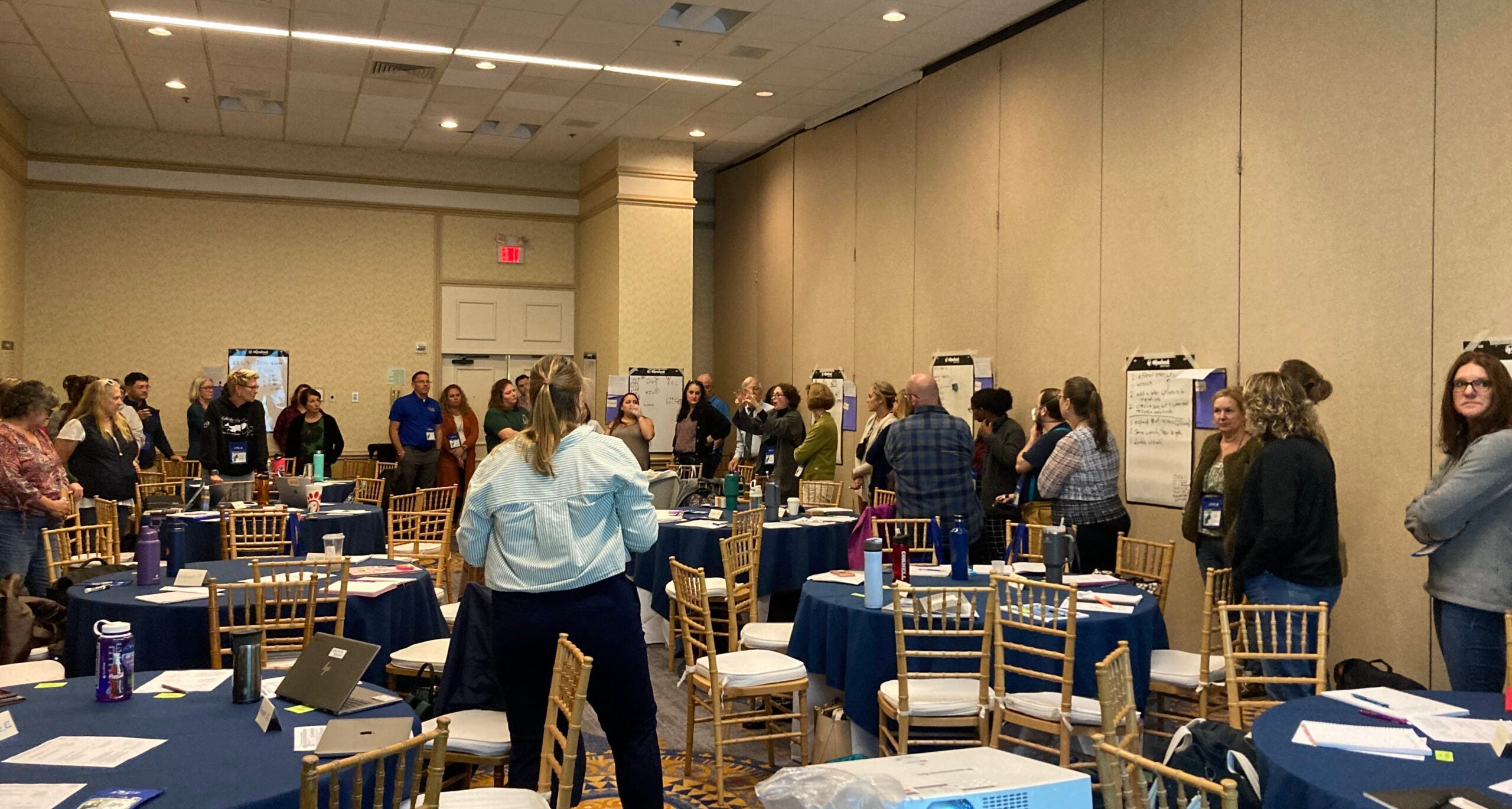
“Someone saw something in me that I didn’t see in myself.” ~CT MTL Fellow
“This program has reinvigorated me. I’m doing things I never thought possible.” ~CT MTL Fellow
The CT Noyce Math Teacher Leaders Project supported a talented cadre of math teachers as they grew from respected classroom practitioners into skilled, confident teacher leaders with state-level influence. In this blog post, we share (1) how the project was intentionally designed to build leadership capacity as experienced teachers stepped into new roles, and (2) how the partnership with the CT State Department of Education (CSDE) was instrumental in building capacity by identifying and creating leadership opportunities for the Fellows. Now in year five, our Fellows have impacted mathematics education in their departments, districts, and across the state. We also share lessons learned and have suggestions for how others – even without a Noyce grant – can advance math teacher leadership to promote a more equitable mathematics education.
A Challenge for all of Mathematics Education
Experienced, accomplished math teachers lack pathways to influence mathematics education beyond their classrooms. Our current models of leadership generally take teachers out of the classroom. The impact is real: our best teachers, who love being with students, leave the classroom as this seems to be the only way to have more impact. We need models of teacher leadership that allow teachers to continue to grow, learn, and expand their influence without leaving the classroom. Such models benefit teachers, students and schools.
Our program was designed to grow teacher leadership while keeping teachers working directly with students in their classrooms.
Who are our CT MLT Noyce Fellows?
Our cohort of 20 Fellows entered the program as experienced (5 years +) and accomplished secondary math teachers who wanted to broaden their impact. Our initial cohort came from 16 of Connecticut’s Alliance Districts – the lowest-performing districts based on the state’s accountability index – and demonstrated a strong commitment to students and advancing more equitable outcomes in mathematics education. They were nominated by their superintendents and completed an application and interview process. These teachers loved teaching and were the “stayers” – teachers who had longer-than-average tenure in districts with high turnover and students with higher needs. They had unique and hard-won knowledge about their contexts. While committed to the classroom, they wanted to do more. Our Fellows recognized that, for math education to improve, systems needed to change; and they saw a need to support colleagues, particularly those new to the profession.
While amazing and committed teachers, many Fellows initially lacked the confidence or know-how to influence mathematics education beyond their classrooms. They wanted change, but were unsure how to expand their leadership. They also respected colleagues’ autonomy and did not feel empowered to propose broader changes outside their classroom or departments.
Overview of CT Noyce Math Teacher Leaders Program
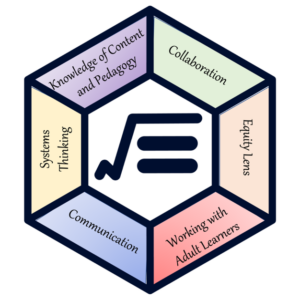
We created a coherent, multi-year program grounded in the Center for Strengthening the Teaching Profession’s (CSTP) Teacher Leadership Skills Framework, which is organized into multiple domains including collaboration, communication and systems thinking. Our program included graduate coursework (four courses over three summers), bi-weekly collaborative learning groups during the academic year, targeted workshops, and extensive opportunities for conference participation, mentoring, and dialogue with a range of educators and professionals.
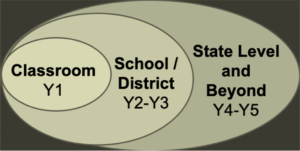
In addition to the CSTP framework, our program was designed to progressively expand teachers’ capacity to influence, moving from their own classroom to the district and school level, and then to the state level and beyond, as shown in the figure.
Further details on our programming are our website.
Program Impact and Products
Our feedback and evaluation measures, including student, teacher and administration surveys, and documentation of Fellows’ projects and impact, indicate we have been successful in developing a cadre of teacher leaders who have advanced a stronger and more equitable math education in their buildings and beyond. They have all engaged in mentorship roles, action research projects, presentations for webinars or conferences, and convenings where they contributed to state-level dialogues about change.
Beyond specific skills and activities, we argue the critical impact of the program was forging new math teacher leadership identities among the Fellows. Through the program, Fellows developed new skills, identities, and perhaps most importantly, new voice, new goals and new spheres of influence. Whereas some opportunities happen within the standard operating of a building or district, we sought out opportunities for our Fellows that extended beyond these. We turn our attention to detailing how the partnership with the CSDE was instrumental in shaping Fellows’ opportunities for growth and impact.
The Critical Role of Partnership as a Lever for Math Teacher Leader Growth
The partnership between UConn and CSDE was critical to our success. The partnership created authentic leadership opportunities for Fellows at the district and state level; opened up access to state decision makers; and demystified policy, which was critical for empowering Fellows in making change, as we detail below. We offer examples – relevant to different years of work with different foci – of how the partnership functioned and its impact, acknowledging that our discussion cannot be fully comprehensive.
Example 1: State Mentoring Program
Like other states, Connecticut requires training for mentors in the state’s induction program (TEAM), which supports new teachers in their two-year induction program and pre-service teachers. In Year 1, our partnership with CSDE allowed us to ensure all Fellows were trained and to contribute to the state’s mentoring program.
For those who did not have that training, Jenn – who serves as the mathematics consultant for CSDE – was able to secure spots even when the trainings had “filled” allowing Fellows to be immediately trained, rather than searching for an opening and potentially waiting for months.
For those already TEAM trained, we arranged with the Talent Office’s Bureau of Educator Effectiveness to have Fellows develop Professional Learning Units (PLUs) to contribute to a bank of online modules that mentors complete to stay credentialed as a TEAM-trained mentor. This PLU initiative was new and none of the existing modules was specific to supporting mathematics teachers. Our Fellows developed three math-focused modules, A Guide to Differentiating Math Instruction Through Task-Oriented Lessons, Equitable Teaching Practices for Mathematics, and Orchestrating Productive Mathematics Discussions that underwent a rigorous review and feedback process and were added to the bank of modules.
This work engaged Fellows with state-level officials in the Talent Office and created the opportunity for them to make a substantive early contribution based on their teaching expertise to support other teachers as well as expand their own knowledge base. Note that having math-specific modules is particularly critical as not all districts (can) assign new math teachers to mentors with math backgrounds. The math-specific modules then provide non-math mentors access to high quality, relevant math content.
These modules and training were effective “early wins”, orienting our Fellows toward their expanded leadership roles and their collective voice and impact. The work was scaffolded and “in their wheelhouse,” leveraging their expertise as classroom teachers, and offered a new audience, namely, other mentor teachers and state officials.
Example 2: Alliance District Symposium

A second critical opportunity, organized through our UConn-CSDE partnership, was created by leveraging and creatively re-envisioning a standing state-level meeting. The Turnaround Office – which provides support and technical assistance to underperforming districts and does not have internal math expertise – convenes the Alliance District superintendents annually, requesting specific personnel (small teams) from the districts to attend. The meeting theme varies, depending on the current needs.
Jenn advocated for the spring 2025 convening to be focused on secondary mathematics education and to have the Turnaround Office partner with CT Noyce to develop the programming. This was a first. Connecticut is strong on literacy but has not historically set a steady gaze on mathematics education. We began our dialogue in May of 2024 and ultimately developed a full-day program focused on secondary mathematics with Fellows integrally involved in the sessions and facilitation. Invited district teams comprised superintendents, STEM curriculum leaders, principals, the Fellows and another (potential) math teacher leader.
The day featured a national keynote speaker, Ted Coe (financially supported by the Noyce grant and CSDE), followed by a panel of Noyce math teacher leaders paired with a district administrator, breakout sessions led by the Fellows, a large-group activity on mathematics programming and pathways (co-facilitated by a Fellow and project lead), and a poster session showcasing the Fellows’ independent leadership projects. The program and materials are posted on the CSDE’s website.
The day was highly successful by many measures. Feedback surveys were positive, with one superintendent calling it the best Alliance District Symposium in over a decade. This event offered the Fellows, literally and figuratively, a meaningful seat at the table as they sat with their district teams, shared their knowledge and experiences, participated in conversations and facilitated activities. The Symposium’s positive impact, reflected in strong evaluations, feedback, and district follow-up, compelled the Turnaround Office to continue this partnership by inviting Fellows to contribute again the following year.
The impact of this event cannot be understated. As with the training modules, Fellows were given an opportunity for new voice and new audience. They were supported in their roles and advanced their influence and positions as leaders. Reciprocally, the successful event offered the Turnaround Office a new vision for a convening, and connected its personnel with a new set of resources (the Fellows) to “tap” to support ongoing work.
Example 3: Building Networks and Connecting Resources
Through the UConn-CSDE collaboration, the Fellows expanded their network and developed new relationships with key actors in mathematics education. These new relationships supported their identities as teacher leaders and provided access to information and new ways to get questions answered, which further enhanced their leadership capacity. Jenn was a key point of access. Fellows could ask her for clarification about policies and request data, whether for their own projects or to better participate in conversations at their schools. This knowledge, critical for leadership, allowed Fellows to ask new questions, push back on interpretations of policy if needed, and to reframe problems and envision alternate solutions.
As another example, we invited the Chief Performance Officer (CPO) for CSDE to present to the Noyce Fellows, sharing information available on the state’s data dashboard, EdSight, and other results. Not only did this empower them with data, but it established a positive relationship. One Fellow followed up with the CPO regarding the possibility of sharing state testing data in a more timely manner to key stakeholders, namely students and families. This conversation was a catalyst for a change in policy at the state level for release of testing data. In addition, many Fellows – having found the presentation so valuable – encouraged the CPO to present at our state-level math teachers’ conference. The CPO and his team subsequently submitted a proposal and presented at the conference in March 2026.
The Fellows and CPO had a reciprocal influence. The Fellows were empowered to access information from state personnel and resources which opened up new connections and opportunities to lead and glean information to problem solve. The CPO gained a new, valued audience and relationships that give him a direct line to a constituent he and his office want to support and impact.
As a third example, more recently, Connecticut became part of the Launch Years Initiative, a project focused on ensuring high quality, rigorous, and meaningful math pathways through high school that align with students’ post-secondary pursuits. Through this work, Fellows have had the opportunity to meet national figures and engage a national dialogue about potential changes. They are also helping to lead the way in Connecticut. Collaborating in small groups, Fellows developed a 4-part webinar series on the potential directions for that initiative which has been posted on the state’s website. The series was viewed by district teams in advance of this year’s Alliance district convening and are publicly available to all. The Fellows again have a new audience – all math educators and leaders across the state.
A Call to Action for States and Districts: Leveraging Key Insights
These experiences – forged through collaboration with CSDE –were significant in shaping individuals’ experiences and growth and the cohort’s journey.
The lessons we have learned through this project have implications for, and offer guidance to, others working in districts with experienced math teachers. These teachers are incredibly valuable resources. We learned, above all, that many experienced teachers want to continue to learn, find ways to increase their influence to address challenging issues shaping inequities in math education, and remain in the classroom.
Expanding their influence and leadership capacity was a powerful way to reinvigorate their practice and advance more equitable math systems and programming in their schools, districts and beyond. Doing so required elevating their voices and forging connections with new audiences, which both reflected and supported the development of new identities as math teacher leaders. We believe all states and districts should pursue expanding leadership capacity of their experienced, accomplished teachers to empower change, expand their teachers’ influence and opportunities for leadership, while keeping these excellent teachers in the classroom.
We offer five suggestions, each related to promoting teacher voice and expanding their leadership opportunities and capacity, which in turn supports their identity development as math teacher leaders.
- Elevate experienced teacher voice. Find opportunities to make their expertise visible.
- Provide experienced teachers with access to knowledge they need to lead and advocate for change. For example, invite experienced teachers to meetings that are scheduled at times they are available or provide other opportunities to engage and learn.
- Leverage partnerships strategically. Identify, or create, partnerships with other districts, the state, or other groups and invite experienced teachers to contribute to meaningful, impactful work. Having a role in a strategic partnership promotes their leadership identities and enhances productive problem solving.
- Invest in your experienced teachers. Allocate funding to compensate teachers. The district has a role in cultivating math teacher leaders and helping people stay energized and committed. Time beyond the standard workday can’t be volunteer work. It is worth the allocated funds; there will be a high return on investment.
- Foster a growth pathway that keeps experienced teachers in the classroom. Give deliberate attention to your experienced math teachers and reflect on the opportunities they are provided. Think about their growth and needs and meet with them to discuss their goals and views. Seek emerging opportunities at the school, district and state level and encourage their participation.
Megan Staples, Ph.D., Associate Professor of Mathematics Education, Neag School of Education, University of Connecticut
megan.staples@uconn.edu
Megan Staples is an associate professor of mathematics education in the Neag School of Education, Department of Curriculum and Instruction, and an affiliated faculty in the Mathematics Department at the University of Connecticut. Her teaching focuses on developing well-prepared secondary mathematics teachers. Her research interests include understanding how classrooms are organized for student sense making and engagement with collaborative inquiry practices, such as justification and argumentation. In collaboration with her wonderful team, Megan is currently the PI for the CT Noyce Math Teacher Leaders grant (Track 3) focused on expanding the leadership capacity and impact of experienced secondary teachers in state-designated low-performing districts. She has also led projects on exploring justification as an equity practice in collaboration with a group of algebra II teachers, examining the mathematical demands of democratic participation, and is a co-founder of the Math Teachers Circle 4 Social Justice. Megan resides in Manchester, Connecticut with her husband and two daughters.

Jennifer Michalek, Education Consultant, Connecticut State Department of Education
jennifer.michalek@ct.gov
Jennifer Michalek serves as Education Consultant at the Connecticut State Department of Education and is a co-principal investigator for the Connecticut Noyce Math Teacher Leaders (MTL) Program. Jenn earned her B.S. in Mathematics and Computer Science with a minor in secondary education and holds an M.A. in Special Education An experienced high school and middle school teacher, Jenn was recognized as Bristol’s 2012 Teacher of the Year. In her current role she provides leadership and support for Connecticut in the areas of mathematics and computer science. Jenn currently resides in Plainville with her husband and their three sons.
