
By:
W. Jason Niedermeyer, Ph.D., Applied Faculty, Pacific University
Kevin Carr, Ph.D., Professor of Education, Pacific University
Elizabeth Gandhi, Ph.D, Managing Researcher, Education Northwest
Ashlie Denton, Ph.D., Managing Researcher, Education Northwest
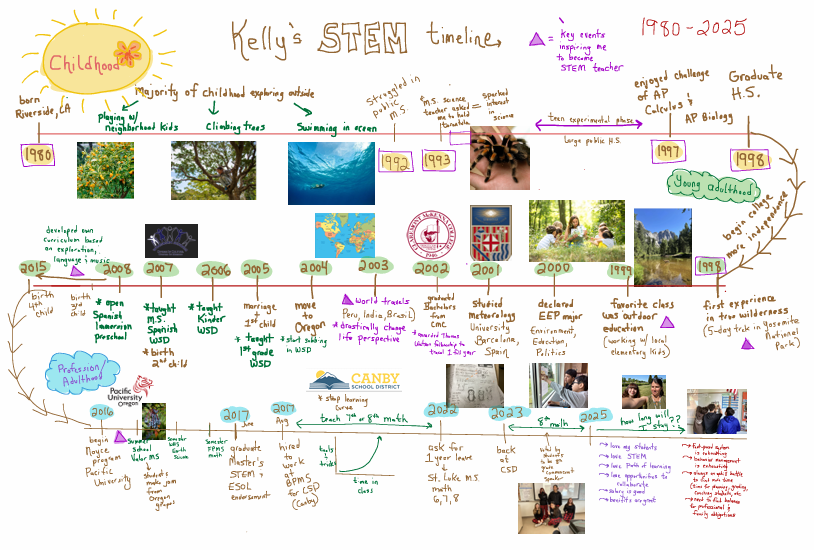
Caption: Example of Teaching Timeline used in the autoethnographic process. View full size.
“I was able to create my own niche at the school.”
-Math Teacher, Narrative Inquiry Cohort #2
How can we better equip and support STEM teachers for long (10 years+) careers in high-need schools? Even people peripherally connected with the field of education are familiar with a disheartening statistic: nearly half of teachers leave the profession within five years (Rinke, 2014). Given the rate at which teachers are leaving the profession, it should come as no surprise that teacher shortages are a pressing issue across all demographics and subjects. The issue of shortages, however, is particularly acute for a couple of key subcategories: 1) schools serving minoritized and low-income students (Borman & Dowling, 2008; Carver-Thomas & Darling-Hammond, 2017; Garcia & Weiss, 2019) and 2) for STEM teachers (AAEE, 2023; Fuentes & Bloom, 2023).
It is these findings that form the evidentiary basis for the National Science Foundation’s Robert Noyce program: to prepare and support the development and retention of high-quality STEM teachers in high-needs schools. The charge of its Track Four program is to evaluate STEM teacher efficacy and retention. While much good work has been done, including the production of a compendium of recent studies rich with both qualitative and quantitative data (Manier & Calinger, 2022), two subsequent reviews of the current state of understanding of STEM teacher shortages concluded, “Although research on STEM teacher attrition has been addressed, the results regarding possible factors that are significantly related to teacher attrition remain largely uninvestigated” (Liu et al., 2023, p. 123) and that the “ … United States’s shortage of useful data [is] a critical problem…” (Craig et al., 2023, p. 209).
Our Noyce Track 4 Project, Understanding the Career Trajectories, Effectiveness, and Retention of Noyce Scholars in High-Needs Schools in Oregon, aims to investigate teacher retention through the lens of individual teachers interrogating their own professional journeys through autoethnography, a research method that interrogates personal experience through the lens of cultural and social contexts. The goal was to mirror the work of Sonia Nieto (2003), using the richness of teachers’ own stories to develop a deeper, ecological understanding of the various interacting factors that contribute to a teacher’s capacity to grow into and remain in the profession. To date, the first two cohorts of teacher-autoethnographers have completed twelve autoethnographies, and our final cohort will complete theirs this year. Through a grounded approach that included participation in their process and an initial thematic analysis of their narratives, we realized the overt use of an ecological lens provides unique insights into patterns that exist across their stories. Beginning with Bronfenbrenner’s (1977) introduction in the 1970s, ecological frameworks have yielded unique insights into teaching for nearly fifty years. Consequently, given the ability of autoethnography to illustrate the ways in which individual teachers work for, within, and even against their educational environments, we wondered whether the ecological concept of niche construction might be the key to teacher retention.
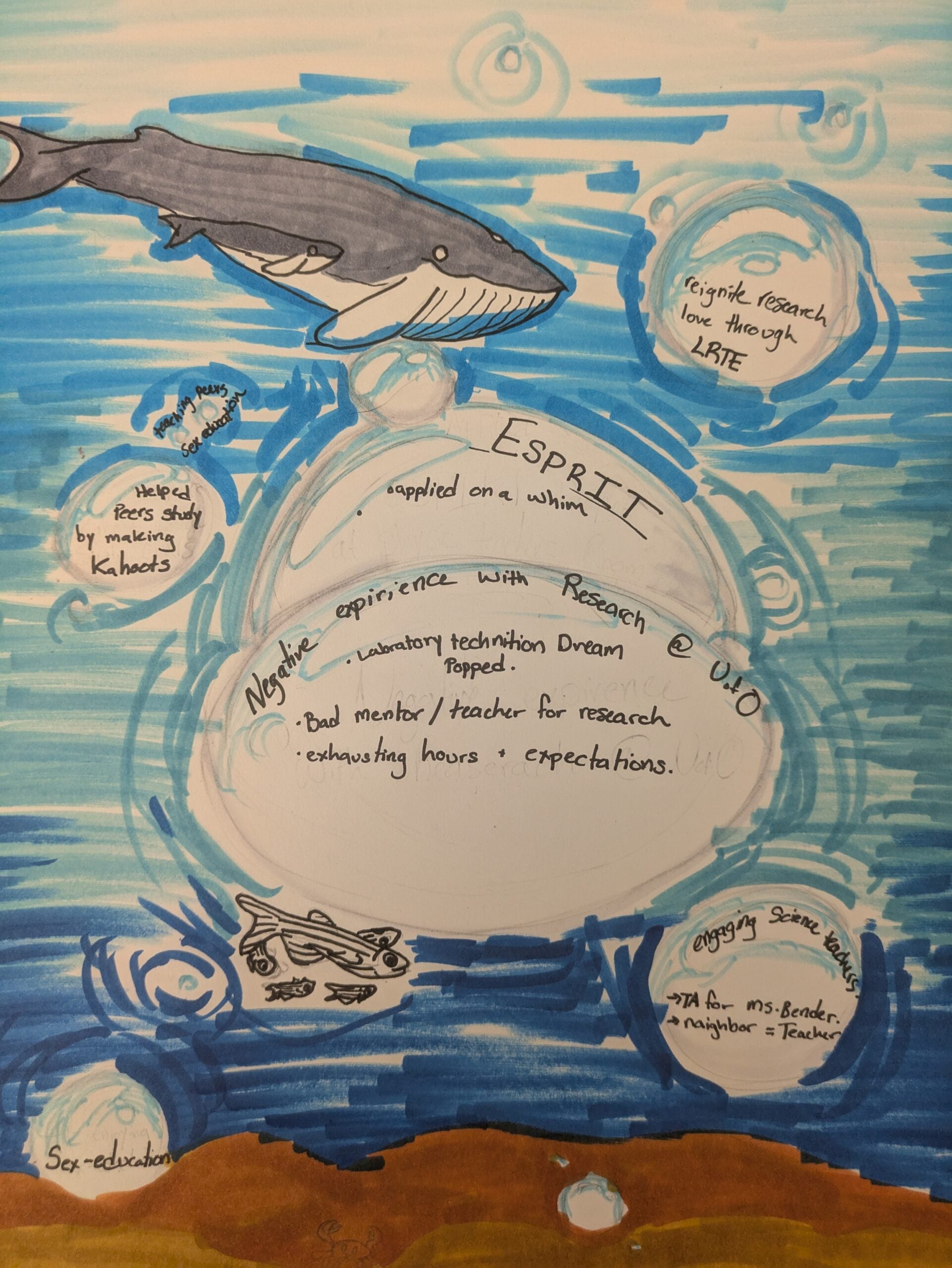
But how might niches and their construction apply to this situation?
Niche Construction
The concept of ecological niches, describes the unique space within an ecosystem where an organism exists and, potentially, thrives (Hardie & Hutchings, 2010; Sexton et al., 2017). The niche concept has been used to analyze the development of teaching as a profession (Kivinen & Rinne, 1994) and has evolved to include various aspects of teachers’ identities (Emmerich et al., 2006; Mao et al., 2021). A teacher’s niche encompasses their sense of belonging shaped by both organizational and relational factors within a school system (Kachchhap & Horo, 2021; Kiral & Kacar, 2016; Pesonen et al., 2021), which is critical to teacher retention (Allen, 2023).
Nearly 30 years ago, the concept of Niche Construction was introduced (Odling-Smee, et al., 1996). This hypothesis suggested that organisms do more than adapt to their environment—they shape it. By altering aspects of their niche, organisms make it better suited to their needs and the needs of the organisms associated with them (Odling-Smee, et al., 2003). For humans living in contemporary society, that means when people are able to actively construct their social environment, they develop skills to anticipate and respond to changing circumstances (Rouse, 2023). We propose that long-term teacher retention and effectiveness relies on occupying and co-evolving a thriving niche within a classroom, school, and community system.
In a recently published book, the philosopher Joseph Rouse (2023) makes a compelling case for Social Practices as Biological Niche Construction. In it he explains that when individuals are in a position to actively construct their niche, they “… develop abilities to track, anticipate, and respond to more wide-ranging circumstances,” (p. 21). However, when there are “misalignments” and they are unable to effectively shape their niche, individuals will frequently make, “ … ineffective modifications [to] recalcitrant circumstances” (p. 152). Rouse’s emphasis on the importance of an individual’s ability to effectively respond in the face of circumstances is evocative of the opportunities and challenges faced by teachers each day in their teaching practice. What seems particularly important for teachers is the space necessary to shape their environment in ways that allow them to “track, anticipate, and respond” to students’ actions, behaviors, and needs.
The importance of there being both alignment with and space to modify their niche was a concept that resonated with several of our teachers’ autoethnographies. It must be noted, however, that the uniqueness of each teacher’s situation means that their niches exist at the individual level, not the population or species level examined by ecologists.
So, what insights can be gleaned from the use of the concept of niche construction on individual teachers?
The Gap between an Optimal Niche and the Limits of Tolerance
For one of our teachers, the kind of “misalignments” that Rouse describes manifested through the absence of a math class built to support a significant need in her school. She writes,
“During our PLC meetings, I brought up my concern about not having any math classes offered in Spanish for our Newcomers…We both knew that our students had the skills to do math but many of them were having a difficult time understanding because the content was in English. We set up meetings with the counseling team and our Dual Language Coordinator. They all supported the decision but ultimately our admin had the final say. Finally, after several meetings with our principal and several months of planning and advocating, our admin approved the addition of 3 Spanish math classes for the second semester.”
This teacher attempted to reconstruct the circumstances for her students and herself, thereby shaping the environment and constructing a better niche for not only her students but herself and the community at large. In the intervening years, this program has expanded, allowing more math classes to be taught at more levels in Spanish, providing more niche space for like-minded teachers and bilingual students.
The decision to make adjustments to one’s niche, isn’t always so glaring; sometimes it isn’t about correcting misalignments but rather “ … reconstructing circumstances to facilitate [latent] abilities” (Rouse, 2023, p. 21). For another teacher who entered the profession by way of behavioral research on arachnids, the change was made to create an environment conducive to her understanding of how students learn to do science. She decided that:
“On Fridays, I [would mimic] my own lab experiences by hosting a journal club. Every student got to lead one over the course of the school year, and each student chose an article and wrote comprehension questions for their peers. The rest of the students came prepared to engage with the article and with discussion questions. We had hot cocoa, tea and snacks and sat in a giant circle as we chatted.”
The inclusion of this experience made her class better suited for the kind of values she was trying to promote: curiosity, collegiality, and an appreciation for science as a process. She noted that the students grew not only as scientists but as people, developing the kind of leadership and listening skills that allowed them to enact their own norms. They were, in essence, learning to craft their own niches–because their teacher had been allowed to construct hers.
From an ecological perspective, both of these teachers were constructing a more optimal niche. But niche optimization can only happen when an individual’s present environment presents a tolerable amount of stress. Stressful situations can be tolerated, but they hardly afford the opportunity to thrive. Often, being forced to persist in stressful situations can lead to individuals and populations having to abandon those environments.
One of our teachers managed to navigate the stresses of the pandemic during her first year as a teacher and attempted to construct her niche by advising two highly successful clubs–science quiz bowl and environmental club–whose missions aligned with her values. But, as a trained chemist her niche wasn’t an ideal fit. She was repeatedly denied in her request to teach one of the many sections of chemistry offered at her large high school. Then she encountered further stressors in her classroom:
“When the rain arrived this fall a puddle in my room also arrived. New to my room I was not aware of the common leaks that happen in our building… The room smelled… I had a student help me look for the smell and little did I know it was from the mold I was sitting next to… The environmental specialist came and tested my walls and said that I could not have students in this classroom anymore… I was just thinking about the month I had been in that room breathing in that mold.”
In the aftermath of her struggle, this teacher began to wonder if she was teaching in the right place. Her initial instinct was to look for jobs at one of the other large comprehensive high schools in the high-needs district where she might get to teach chemistry, but after she interviewed with a private school, it became clear that they valued her for more than her ability to make the best out of a bad situation; they valued her for her expertise. For this teacher, it was clear that her fundamental niche encompassed what she perceived to be her optimal niche–teaching chemistry in a mold-free classroom–but it couldn’t be realized because she was competitively excluded from the resource she needed most: the opportunity to teach chemistry.
How to Construct Your Niche
So, what can be done?
While it is clear that teachers’ niche space can be fundamentally constrained by the educational system as constituted on the national and state levels as well as decisions made by district and building level administrators, the initial analysis of our participant’s stories provide us a window into potential actions that teachers can take. While none provides anything close to a guarantee of optimization, it may move teachers out of the zones of stress or at the very least provide a buffer where environmental stressors are present.
Establish Autonomy
Our teachers’ autoethnographies made clear that finding ways to establish autonomy was a frequent key to constructing niches. Whether it was something as small as making changes to the adopted curriculum or as large as designing an entire class from scratch, these exhibitions of agency are representative of the kind of epistemic autonomy that the philosopher Catherine Elgin (2025) considers critical to developing an epistemic ecology. But Elgin suggests that to have a healthy epistemic ecology, that autonomy must be paired with epistemic interdependence–having people around you whose knowledge and processes for acquiring knowledge you can trust. And for each of our teachers who exhibited autonomy, its successful deployment ultimately relied on someone else to either validate or support the action they were taking.
Develop a Network
Another action teachers can take is to fortify what Noyce literature on teaching retention has labeled their network (Alemdar, et al., 2022). In an ecological sense, this would mean attending to your symbiotic relationships. Ensuring that you have a number of mutualisms (relationships that are beneficial to both parties); colleagues you enjoy working with typically fill this role. Commensal relationships (relationships that benefit one party while being neutral to the other) are also important–effective mentorship maps neatly onto this symbiosis. But it is equally important to avoid negative relationships. Several of our teacher participants noted the importance of not spending too much time with colleagues who evince negativity and pessimism; basically to rid yourself of parasites.
Personal Identity
A third and (hardly) final way that teachers can make their niche space more habitable is more inward looking. For many of our narrative participants, teaching was a salient and even seminal part of their identity…but there was more to each of them than teaching. Being able to bring pieces of themselves untethered to teaching but central to their lives made their classroom feel more like home. Whether it was recognizing the importance of the outdoors and getting students out into nature, or bringing their enthusiasm for technology into the classroom, having that part of their personal identity be a presence in their classroom was essential for constructing their niche.
One of our participants may have put it best when they wrote,
“In the early weeks of my first year teaching, [a fellow teacher] told me the trick to getting kids to like you was to develop a unique persona and go all in on your interests (I would guess my own eighth grade science teacher would subscribe to this perspective, too, as he had his room plastered in Chuck Norris references and often stopped class to play us songs on his guitar.) Developing some sort of quirky persona for the classroom never felt genuine to me, though. I just did my best to teach and be myself and hoped the rest would follow.”
So, could it be said that the keys to teacher retention are: be yourself, build a network, and exhibit autonomy?
No–educational ecosystems are complicated and niches are forged by a near infinite set of factors including many that are out of their control. But we are beginning to think that the teachers who are allowed and able to construct their niches might just be the ones who are most likely to keep doing it because it feels like they’ve found a space meant for them.

W. Jason Niedermeyer, Ph.D., Applied Faculty, Pacific University
wniederm@pacificu.edu
Dr. Jason Niedermeyer is an applied professor of education with expertise in educational philosophy, the science of learning, and researcher of teacher retention. He has had recent publications in the journals International Dialogues in Education, American Biology Teacher, and Advances in Literacy and Language Studies on topics ranging from the role of storytelling in education, the power of wonder in the classroom, and the cognitive benefit of reading slowly. Prior to coming to Pacific, Jason spent two years as an instructional mentor for Salem-Keizer school district, the same district where he served as an English and science teacher for fourteen years. Jason is married to a fellow educator, Vanessa, and they have two sons, CJ and Ryan, who he coaches in football and baseball.

Kevin Carr, Ph.D., Professor of Education, Pacific University
kcarr@pacificu.edu
Kevin Carr is a Professor of Science Education at Pacific University in Forest Grove, OR. His work centers around science teacher preparation and retention. Specifically, he focuses on the role of autoethnography and teacher identity development in shaping teacher career trajectories.

Elizabeth Gandhi, Ph.D, Managing Researcher, Education Northwest
Elizabeth is a managing researcher with over 20 years of experience in education research, evaluation, and technical assistance. She is currently co-leading a research practice partnership with Pacific University on the National Science Foundation-funded project Understanding Noyce Scholar Career Trajectories: What Keeps Noyce Scholars Going? and leading a National Science Foundation funded study, Gauging Enduring Language and Racial Equity Pedagogy in STEM. Other STEM focused recent work includes partnering with Oregon State University to support the Language, culture, and knowledge-building through science project, funded by the National Science Foundation through ongoing technical assistance and evaluation services.

Ashlie Denton, Ph.D., Managing Researcher, Education Northwest
Ashlie brings nearly a decade of experience in multidisciplinary STEM research, evaluation, and strategic planning. She currently serves on the research team for Understanding the Career Trajectories, Effectiveness, and Retention of Noyce Scholars in High-Need Schools in Oregon and has contributed as an external evaluator for four NSF-funded Robert Noyce Teacher Scholarship programs at Pacific University and Vanderbilt University. Her recent work includes equity-centered strategic planning for STEM and career education initiatives, mixed-methods evaluations of in-school and out-of-school STEM programs, and a national landscape scan of STEM out-of-school time programming.
