By:
Caitlin M. Donovan, Ph.D., Assistant Director, Duke University
W. Collin Dail, Earth Science and Environmental Science Teacher, Durham Public Schools
Alexa Epstein, Teaching Candidate and Noyce Scholar, Duke University
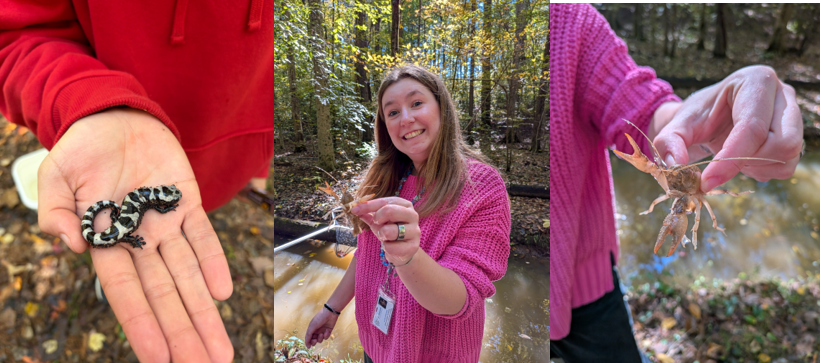
Caption: Duke MAT Candidate and Noyce Scholar Alexa Epstein and her student share the stream organisms they found in a field study at a local stream. View full size.
Current public-school teacher and Noyce Scholar Collin Dail (Duke MAT 2022) together with his Noyce teacher-intern Alexa Epstein (Duke MAT 2026) discovered that teaching environmental science primarily through abstract, global concepts left students, especially English Language Learners, disconnected and hesitant to engage in even the ‘cool’ parts of class. They found that their students needed to actively participate in an activity or lab to truly be involved and learn from a lesson. This realization prompted them to design a hands-on stream study to bridge knowledge with authentic classroom practice and student engagement. To create this stream study experience, Collin mentored Alexa in planning a student-centered, inquiry-based activity; the pair requested nets, jars, and buckets to capture fish and macroinvertebrates in a local stream. Students were able to practice data collection, animal identification, and graphing skills with a data set that they created.
One persistent challenge in preservice STEM teacher preparation is bridging the gap between disciplinary knowledge and authentic classroom practice, particularly in environmental science where learning is inherently place-based but often taught in terms of high-level, global-scaled phenomenon (Framework for K–12 Science Education). Additionally, several studies have documented a significant correlation between teacher self-efficacy (beliefs about one’s ability to positively impact student learning and success) and increased student achievement (Mojavezi & Tamiz, 2012; Tournaki & Podell, 2005; Tschannen-Moran, Hoy, & Hoy, 1998). Mentorship provided by an experienced teacher facilitates the growth of this early-career teacher self-efficacy. The Duke MAT Program’s NSF Noyce funding and support allowed this Noyce Mentor Teacher/Teacher Candidate duo to help their students engage with the community and their standards, all while building their students’ identity as scientists.
Alexa noted, “When introducing the lesson to my class, one student, Carolina (pseudonym) specifically looked extremely unhappy with the idea of going outside, behind the school, and down by the stream. When we got through the forest and to the stream, she didn’t even want to hold a net! … But after some time, I looked over and saw Carolina was elbows deep in a pile of wet leaves she had pulled out of the stream looking for organisms. Even after hesitation, my most cautious and shy student was getting her hands dirty and loving it!”
Program Context
Noyce Scholars are selected members of the larger Duke Master of Arts in Teaching (MAT) Program, an accelerated teacher preparation and licensure program that prepares candidates to enter classrooms as culturally responsive educators equipped with the skills and content knowledge needed to support the learning of all students. This 12-month program provides pedagogical expertise via two unique internship experiences, totaling a 27-week internship period with two experienced mentor teachers. In addition to MAT core programming, Noyce scholars receive dedicated professional development, research support, and exclusive access to the Learning Lab.
As part of the NSF Robert Noyce Teacher Scholarship Program, the Duke MAT program supports our Noyce Learning Lab, which provides STEM supplies for both current and former Noyce Scholars to design field-centered experiences and interventions for their students. Some scholars have chosen to work with 3D printers, helping their physics students design and print unique cars for a track race. Several math teachers requested calculators and whiteboards for game-based review projects. Other teachers thought outside the classroom and focused on materials that could help students engage in place-based learning in the community.
Description of Activity (Learning Objectives and Program Design)
Considering their student needs and the North Carolina standards for environmental science, Collin worked with Alexa to design a structured field investigation for their two environmental science classes; conducted at a local creek within walking distance of the high school, they considered how they might have their students think like scientists and engage in authentic scientific practice. They decided to stage a guided inquiry (Kirschner et al., 2010) where students would work in small research teams to conduct ecological observations, document species presence, and sample habitat conditions.
This learning segment centered on a structured, place-based field investigation designed to make stream ecology relevant to students through practice in direct inquiry; teachers posed the inquiry question “How healthy is our stream?” to provide a gateway into the learning objective: I can explain how biodiversity levels reflect stream health using data I collect.
The stream study was tied directly to the following North Carolina science standards:
- EES.5.2 – Analyze and interpret data to evaluate how human use of ground and surface waters impacts water quality and availability in river basins, wetlands, estuaries, and aquifers.
- EES.4.5 Obtain, evaluate and communicate information to explain how biodiversity impacts ecosystem resilience.
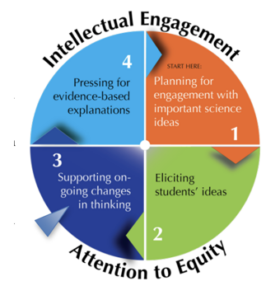
Caption: A diagram of the framework provided in Ambitious Science Teaching. View full size.
Activities like data collection, analysis, and explanation of findings reinforced in-class practice while exposing students to community-based science. Alexa combined Collin’s mentorship with theory from a course with another NSF PI, Dr. Matthew Reynolds, to create an engaging lesson for her students. She comments, “Through using the framework provided in Ambitious Science Teaching (Windschitl et al., 2018), I was able to create a hands-on lesson by engaging students in a real-life and applicable phenomenon, eliciting students’ ideas, supporting changes in their thinking, and pressing for evidence-based explanations.”
Additionally, literacy objectives were integrated to support sense-making and develop discourse. Students documented their observations and described the diversity of life found in a local stream, using evidence from their samples to justify claims about ecosystem health. Sentence stems would support multilingual learners in describing their organisms and work to build spoken and written communication skills necessary for scientific explanation.
Noyce funding addressed the primary constraint of this investigation: access to appropriate field materials. Nets and buckets enabled safe, ethical, and minimally invasive sampling, which protected both students and organisms while making authentic ecological study feasible in a high school context. To secure funding, Collin and Alexa reached out to Caitlin Donovan, Noyce research and project coordinator, who oversees the Duke MAT program. Caitlin understood the needs of their project and was able to allocate funding from the Noyce MAT program that allowed Collin and Alexa to shift from hypothetical discussions with their students to embodied scientific practice, strengthening both student engagement and conceptual understanding.
Outcomes
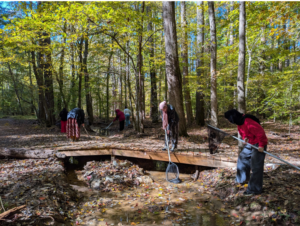
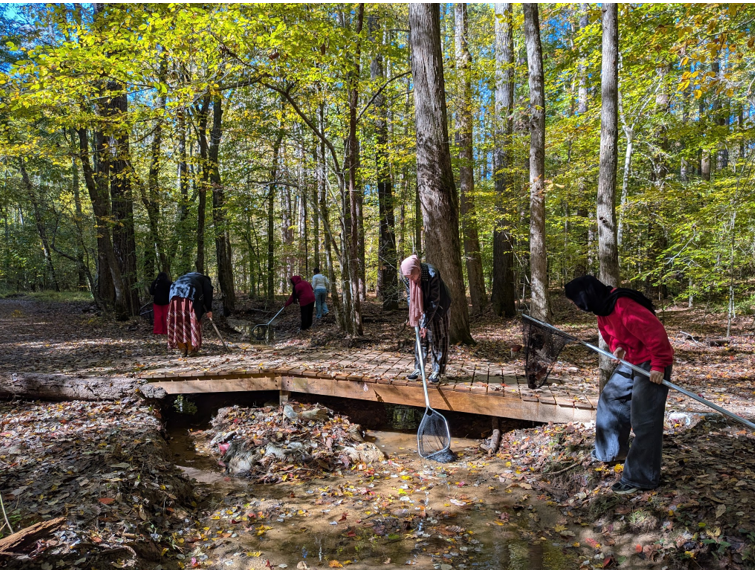
Caption: Students sampling the creek for fish, invertebrates, and other local wildlife. View Full Size.
These Noyce scholars reported positive outcomes for both their students and themselves as teachers. By exploring the creek near the school, students experienced science as an active, outdoor endeavor, increasing curiosity and confidence in exploring the natural world and applying what they learned in the classroom outside of it. They strengthened their scientific discourse by describing field-based observations and explaining the relationship between biodiversity and stream health; developing literacy skills that are transferrable across disciplines. Furthermore, Collin and Alexa saw higher assessment scores on this unit compared to more traditionally taught units, proving engagement and learning. For the rest of this unit, students requested to go back to the stream and shared interest in going back for other units. Collin and Alexa even heard students from other class sections sharing stories from other classes as they were all discussing the experience out of class.
Collin reflected that this project refined his mentoring skills, particularly in learning how to support and scaffold the implementation of “engaging activities that push the boundaries of ‘normal’ classroom teaching”. Alexa, in turn, gained readiness and experience in designing place-based, inquiry-oriented curriculum. Leading this field study, from conceptualization through enactment to reflection, strengthened her ability to implement theory as practice in her classroom.
The Noyce program, through resources and intentional mentorship, directly impacted the growth and scientific identity of students and teachers in our local public schools. The success of this mentoring relationship and learning segment validates the Learning Lab model, proving how small investments in classroom initiatives with well-informed teachers can have enormous instructional impact on not only students in our classrooms, but also the instructional potential of teachers.
Implications
For Noyce Mentor Teacher Collin, this work underscores the value of the NSF Duke Learning Lab as an enabling structure for effective mentorship; Collin was able to support Alexa’s inquiry vision and help her think outside the textbook. As Collin reflected, “I’m finding that the best way to support my mentee is to encourage constant exploration and innovation. Providing scaffolding and guidance in implementing mentees’ ideas is critical to them discovering what works best for themselves and for students.” The Learning Lab allowed Collin to focus on high-leverage mentoring moves, such as planning support and logistical oversight, while deliberately stepping back during the inquiry: “My job in this situation was to provide planning support and logistical oversight, and then to stay out of Alexa’s way.” This balance positioned the mentor as a facilitator of Alexa’s professional growth rather than a gatekeeper of his intern’s instructional decisions.
For Noyce Scholar Alexa, this experience showed the power of a mentorship approach that balances support with autonomy. Thinking about her time as Collin’s intern and this project, she reflected, “effective mentorship isn’t about control, but about providing the necessary scaffolding and resources to allow a mentee to explore, experiment, and find themselves as an educator.” This experience also showed Alexa how thoughtful structures and planning can have an immense impact on students’ learning; by planning and leading an inquiry-based lesson, she observed how active students became in learning through collaboration with peers, experimentation, and the creation of their own scientific identities. When projects like the NSF Noyce Grant and Duke learning lab support teachers in innovative endeavors, students benefit through real, authentic engagement and the development of a deep understanding of the content and scientific methods.
For Collin, Alexa, and the program, the clearest implication was the impact on students’ learning and agency. By engaging as scientists and explorers in the field, students collaborated authentically with one another and with their local environment, moving beyond passive content consumption to active inquiry and scientific identity (Carlone & Johnson, 2007) building so that all students could see themselves as scientists. Based on Collin and Alexa’s observational reports, this hands-on experience fostered a deeper appreciation for scientific inquiry and better equipped students to make informed, responsible decisions about environmental issues, reinforcing the role of place-based science as both an academic and civic activity.
This learning lab serves as a model for leveling the playing field for multilingual learners. The students who participated in this activity were placed in a sheltered English Learner section of Earth Science, in which curriculum is differentiated and scaffolded to meet both curriculum and linguistic needs. The stream survey lab centers direct engagement in tangible science as the pathway for accessing new vocabulary through Task-Based Language Teaching. Students described their data and used higher-order thinking skills to evaluate stream health, but only after all learners engaging in data collection that transcends language barriers and is fueled by physical practice, luck, and fun. In this way, students were able to view themselves as critical thinkers and scientists.

Caitlin M. Donovan, Ph.D., Assistant Director, Duke University
Caitlin M. Donovan, Ph.D., is Assistant Director of and faculty in the Master of Arts in Teaching Program at Duke University, as well as the Duke Noyce Project Coordinator. Formerly a 6-12 classroom teacher in Durham Public Schools, she works extensively with community-based organizations and with pre-service teachers to develop critical literacy and pedagogical practices.
W. Collin Dail, Earth Science and Environmental Science Teacher, Durham Public Schools
W. Collin Dail teaches Earth Science and AP Environmental Science at Jordan High School with Durham Public Schools in Durham, NC. He focuses on supporting multilingual adolescents and English Language Learners by removing linguistic barriers to science education. Collin was selected as his school’s 2025-2026 Teacher of the Year.
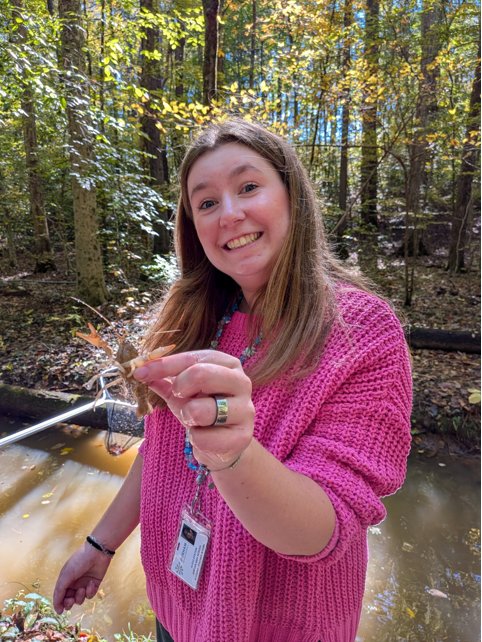
Alexa Epstein, Teaching Candidate and Noyce Scholar, Duke University
Alexa Epstein is a Duke University Master of Arts in Teaching candidate and Noyce Scholar. She completed her student-teaching internships at Jordan High School and J.D. Clement Early College High School within Durham Public Schools. She is committed to engaging students through hands-on, experiential science learning to foster curiosity and deep understanding.