
By:
Wendy Jackson, Ph.D., Senior Curriculum and Professional Learning Specialist, Lawrence Hall of Science
Maia Binding, M.S., Senior Curriculum and Professional Learning Specialist, Lawrence Hall of Science

All students should have the opportunity to learn about science in the context of real-world issues. Using the context of socioscientific issues to center science teaching and learning helps students see the relevance of science to their everyday lives and the lives of others, and the role science plays in speaking to complex real-world issues (Sadler & Dawson, 2011; Sadler et al., 2016.) This approach also helps teachers, especially new teachers, to navigate a frequent challenge—lack of student engagement (Topcu et al. 2010.) When students are presented with real-world problems with complex solutions that involve trade-offs, they are more likely to take an active role in their own learning (Carroll Steward et al., 2023.) This approach respects their intellect and challenges them in authentic ways (Jackson et al. 2023, Koo et al., 2024.)
Our Introduction to Issue-Oriented Science
Our personal experiences as science teachers, which began over 20 years ago in urban school districts, underscored for us the value of an issue-oriented approach for beginning teachers. Maia taught high school in the San Francisco Unified School District. As a new teacher, she was provided with a traditional textbook and no supporting curriculum. Her students had difficulty understanding the text, and while many showed interest in laboratory and other hands-on activities, their understanding of the content was often surface-level and perfunctory. When she began incorporating socioscientific issues into her lessons, she observed an increase in students’ active participation in discussions such as asking questions and sharing their wonderings. This was particularly noticeable for students who had been previously disengaged. Over the next several years, she worked to craft her own cohesive issue-oriented curriculum for the full year, using different issues for each of her curricular units, to harness this increased student interest in learning science.
Wendy began teaching in Chicago Public Schools as a Noyce Scholar through a program for career changers (the Middle Grade Science Program [MGS] at the University of Illinois at Chicago.) In her first year of teaching, she had no textbook or instructional materials and struggled to piece together a meaningful curriculum. During her science methods course, she was introduced to issue-oriented science curricula from the Science Education Program for Public Understanding Program (SEPUP). She knew that she wanted to use real-world issues as the context for student learning, and her goal was to have students make connections between what they were learning in class to their outside lives. However, crafting a curriculum from scratch while teaching in a high-need school proved challenging. In this first year, students showed modest interest in the science they were learning, and Wendy noted: “Something was missing from my classroom, or at least not as prevalent as I would have hoped. Students were not asking the kinds of questions, generating discussions, or providing written responses that showed they were using what they were learning in science lessons outside of the science classroom. While students typically answered the questions I asked during class, their responses seldom generated additional questions or comments…” (Mitchener & Jackson, 2012).
Because Wendy felt like her lessons were falling flat, she lobbied successfully for her school to adopt SEPUP starting in her second year. She witnessed the same increase in student engagement as Maia. Students began making spontaneous connections between what they were learning in class and their lives outside of school. They also demonstrated more sophisticated sensemaking of science ideas. For example, during a learning sequence on diseases, Wendy was able to model for students how understanding the science helped her understand what was happening to her dog that had fallen ill with a heart condition. Students began making similar connections. They began telling stories in a class of medical incidents and information they learned from health-related experiences in their families. Students talked about grandmothers and uncles who had high blood pressure or had suffered a stroke. Students also told the class their own health stories. One student shared that he was born with a hole in his heart. This led to a class discussion about why this student’s heart condition was problematic, with students drawing upon what they had previously learned about the heart. The class also discussed how surgery successfully fixed this problem. By focusing on these real-world, tangible health issues, students became invested in learning about the science. When later invited to work with preservice teachers, Wendy continued to draw on SEPUP’s issue-driven approach as a way for these teachers to engage students more readily and authentically in science learning.
Issue-Oriented Science Teaching and Learning in the Classroom
What does issue-oriented science teaching and learning look like? Issues can pertain to any science content area. For example, the issue of vehicle and driver safety can be used to explore concepts in physics. The question of where to build a new wind farm can anchor an instructional sequence exploring concepts in the geological sciences. The problem of what to do with waste in the computer industry can provide the focus for a unit on chemical reactions. We provide an example from a SEPUP high school biology curriculum, which we both designed.
Sustainability as a Socioscientific Issue
This curriculum is situated in the global context of sustainability. Students are introduced to a framework for sustainability that involves three pillars: 1) The economic pillar includes information on how the action affects the economy. Does the action create or take away jobs? What is the financial cost or benefit of implementing the action? 2) The social pillar considers information about how the action affects the social aspects of the community. Does it protect or improve human health? How does it affect the local community in terms of food availability or human interactions? 3) The environmental pillar considers the effects on the environment. Does it protect or endanger critical ecosystems? Does it create or reduce pollution?
Each unit is centered on a specific issue related to sustainability that requires understanding particular science concepts and ideas in order to make decisions about that issue or find potential solutions to its problem. Recognizing the trade-offs of these decisions and solutions is a critical aspect of this curriculum. The issue is examined from the perspective of multiple stakeholders, and the trade-offs associated with a decision or perspective are identified. Throughout the course, students learn what it means to evaluate scientific evidence, how to base an argument on scientific evidence, and how science and society are intertwined and interact. Many issues that lend themselves to teaching students methods for evaluating evidence and making evidence-based decisions have no obvious “correct” answer—especially when non-scientific criteria are considered. This consideration of factors that may have to do with mental health, economics, or politics permits students to bring their individual perspectives to the discussion and can raise the voices of students who might otherwise stay silent.
Students begin the ecology unit by considering that throughout the world, people, communities, and countries rely on natural resources for many uses. The ways that people use these resources can be unsustainable. Fish and other marine organisms are important natural resources that are a source of food as well as income for many people throughout the world. Students are first asked to share their initial ideas about fisheries, with the teacher asking open-ended questions that allow students to consider fish and/or fisheries in their local context. Teachers are reminded that students living in inland areas may not consume much fish in their own diet, but they may have connections to fishing through recreation. Other students may have ethical reasons for not supporting fisheries, which can lead to discussions about balancing one’s own viewpoints with the needs of other stakeholders and about equitably balancing trade-offs. In this way, all students can contribute to an initial discussion about fisheries. Teachers in field tests and pilots around the country in a wide variety of settings were pleasantly surprised by how students were able to make personal connections to this issue. Teachers from the Midwest and New England share their feedback.
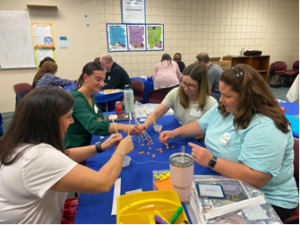
Students are then presented with the problem of how scientists determine if an important fish population is declining, increasing, or remaining stable. Because they are more connected to and curious about addressing this question, students are more likely to persevere in understanding different methods of estimating population size. They use hands-on models to simulate the standard high school biology topics of the mark-and-recapture and quadrat sampling methods for estimating population size. However, these topics are now connected to an issue the students have begun to ask their own questions about. Next, students are tasked with understanding exponential population growth, and limits to such growth due to both biotic and abiotic factors—again, content found in most biology textbooks. Here, though, students apply their learning to the question of whether a fishery is sustainable or not. The storyline connecting the issue to the science content helps students develop a growing level of sophisticated understanding.
After additional learning sequences focusing on the cycling of matter and flow of energy in ecosystems, as well as natural and anthropogenic disruptions to ecosystems—always in the context of sustainable fisheries—students apply their knowledge and understanding to make recommendations about a hypothetical fishery. Before doing so, they explore four real-world case studies, each adopting a different strategy. These strategies include: using the concept of maximum sustainable yield to determine fishing quotas; establishing a marine reserve and prohibiting all fishing; establishing aquaculture pens to raise fish in captivity; and creating restricted fishing areas, illustrated with an example of the use of the tabu in Fiji, a cultural practice of temporarily restricting fishing in a specific area. In addition to examining the scientific evidence relevant to each strategy, students must also consider the trade-offs involved in each.
As with any curriculum, but especially one focusing on socioscientific issues, finding a way to localize the issue is highly desirable to engage students more fully. As one teacher said about the SEPUP ecology unit described above, “I really enjoyed the storyline. I added in some information about the New England fisheries and its history in comparison to the Pacific fisheries.” This teacher was able to adapt the curriculum by bringing in local examples that students are better able to relate to. The teacher added, “It is important to be able to tweak the unit based on where we live.” We agree with this stance, and we note other prominent voices in science education who have crafted issue-based curricula focusing on local issues, such as Daniel Morales-Doyle and his colleagues in Chicago Public Schools, who developed high school science curricula centered around a coal power plant in Chicago’s Little Village neighborhood, and Natalie Davis who developed a science unit for elementary school around the Flint, Michigan water crisis. Teachers, especially new ones, do not need to create issue-oriented curricula from scratch. Rather, they can use, adapt, and learn from these and other vetted curricula, focusing on finding ways to tailor the curriculum to their local situations and their students’ interests.
Implications
In conclusion, an issue-oriented science curriculum uniquely engages students by connecting scientific concepts to real-world issues, making learning relevant and meaningful. As new teachers, we found this approach helps significantly with getting students to buy in, and we encourage other new teachers to consider it for their classrooms. We also recommend that teacher education programs provide preservice teachers the opportunity to learn about and gain practice with issue-based curricula. Beyond the benefit of increased engagement, using an issue-based approach fosters deeper understanding, critical thinking, and active participation. Students learn to evaluate evidence, consider diverse perspectives, and understand trade-offs in scientific decision-making by exploring topics such as sustainable use of natural resources, the impact of waste products on the environment, and the development of alternative energy sources. This method not only enhances scientific literacy but also prepares students to thoughtfully address complex societal challenges, nurturing informed and engaged future problem-solvers and innovators.
Acknowledgement
 Thanks to Thomas M, Philip for serving as an editor for the 2024 ARISE blog series and for working with Wendy and Maia on their blog. Read his blog, Recognizing the Significance and Consequentiality of the Moment in Transforming Classrooms to Equitable, Just, and Democratic Places of Learning.
Wendy Jackson, Ph.D., Senior Curriculum and Professional Learning Specialist, Lawrence Hall of Science
wendy.jackson@berkeley.edu
Wendy Jackson is a Senior Curriculum and Professional Learning Specialist with SEPUP at the Lawrence Hall of Science and lead author on several units in SEPUP’s middle school program and high school biology programs. Before joining SEPUP, she was a middle-grade science teacher in the Chicago Public Schools and then became the district’s lead teacher for middle school science. Wendy received a Ph.D. in Ecology from the University of Washington, having conducted her dissertation research in Kenya, and was a faculty member in biology at the University of Illinois at Chicago. She also served as a AAAS Science and Technology Policy Fellow at the USAID.

Maia Binding, M.S., Senior Curriculum and Professional Learning Specialist, Lawrence Hall of Science
mbinding@berkeley.edu
Maia Binding is a Senior Curriculum and Professional Learning Specialist with SEPUP and also serves as Director of the San Francisco/Bay Area Center for the Amgen Biotech Experience, providing professional development, curriculum, and materials for area teachers to teach biotechnology. Maia spent nine years directing projects to develop hands-on, informal science programs for middle and high school students in Saudi Arabia, including delivering professional development for Saudi teachers at the Lawrence Hall and in Saudi Arabia. She began her career teaching high school biology in San Francisco. Maia holds a bachelor’s degree in Integrative Biology from the UC Berkeley, and a master’s degree in Animal Sciences from the University of Hawaii, Manoa.
