By:
Sanlyn Buxner, Ph.D., Research Professor, University of Arizona
John Keller, Ph.D., Director, Fiske Planetarium; Professor, Astrophysical and Planetary Sciences, University of Colorado Boulder
Larry Horvath, Ph.D., Professor Emeritus Secondary Education, San Francisco State University
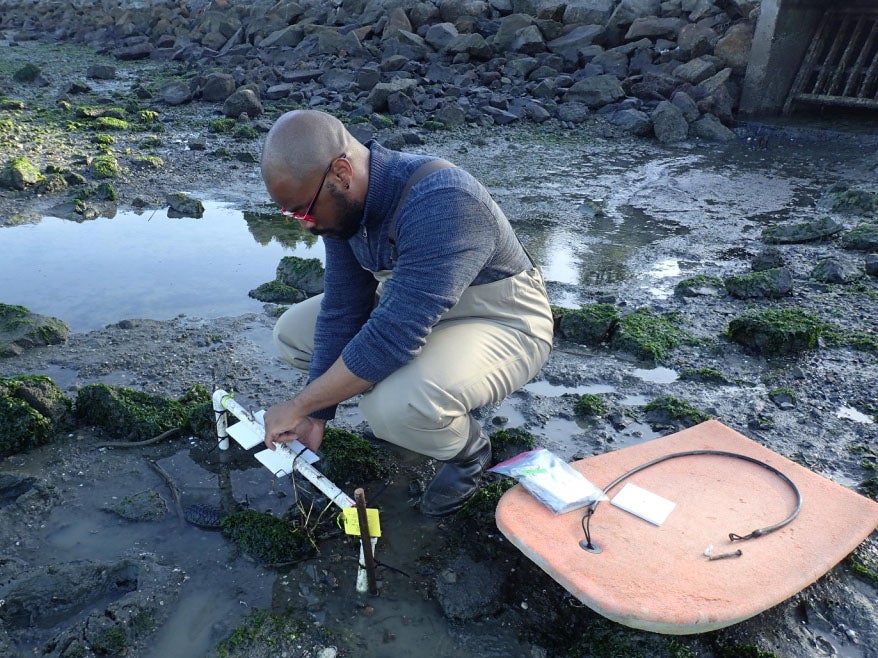
Caption: STAR Fellow Jason Thomas works to set up an oyster population monitoring system during his summer research experience.
Background
Engaging students in authentic STEM experiences is a core goal of many who work in science education. This goal is not only a part of local, state, and national standards, but is also a way for students to better understand different STEM disciplines in order to increase their competence and confidence in making evidence-based decisions in the classroom and informed choices as citizens (Hagib & Gupta, 2021; Hilton & Hilton, 2024; Stephens, Brenner, & Gentile, 2017). Additionally, we want students to understand the broad STEM career options available to them and feel empowered to take actions towards pursuing those careers.
As a group of science teacher educators and education researchers, we are committed to supporting teachers to engage in authentic STEM experiences and to help them transfer these experiences and ideas into their classrooms. As with many content areas, STEM fields are best learned by direct engagement with the subjects. The same applies to learning to do research. Despite this, many preservice teachers are not afforded the opportunity during their preparation to engage in research. Over the years, different ways to address this need have been tested nationally, including student engagement in classroom undergraduate research experiences (CUREs) (Krim, et al., 2019) or in summer research inquiry experiences.
Research Experiences for Teachers
We are strong advocates for supporting teachers participating in research experiences as practicing teachers. We have, collectively, spent the last 20 years supporting and researching these experiences and their impacts.
Research experiences for teachers (RETs) represent a broad set of possible experiences implemented in labs, field sites, and medical facilities with the core goal of engaging teachers in research. RETs provide an active, mentored space for educators to work on real problems, answer novel questions, and analyze real data to answer questions and provide solutions. Projects might include collecting and analyzing data in the field or in a lab setting, analyzing pre-collected data, or running and testing computer models. The number of possible projects is broad, exciting, and aligned with current STEM research being conducted across the country.
Often, RETs are equated to research experiences for undergraduates (REUs) which are also mentored experiences for students to learn how to do research. We postulate that RETs are fundamentally different in several ways. First, RETs are intended to engage teachers in research experiences with the explicit intention for participants to be a part of the research enterprise and to help them translate their experience into their classrooms. To do this, most RET programs include elements focused on pedagogy where teachers work on curriculum and receive guidance on how to create classroom research experiences. Feedback from mentors has consistently demonstrated that teachers are smart, capable, and productive, often exceeding the expectations of new mentors. The point is not to train teachers to be STEM professionals and take them out of the classroom but rather to re-energize them by doing authentic science and helping them bring new excitement and ideas into their classroom.
RET Program Case Study: STEM Teacher as Researcher
The authors have been running and/or supporting RET programs for a long time. One of us (J. Keller), previously participated in an RET as a high school teacher and experienced the benefits firsthand. All three of us have supported teacher research for many years in different settings. Assessments of such programs often reveal positive outcomes for teachers but less commonly follow up on how the experience might change teachers’ practice or impact their students’ learning. In fact, very few studies of RETs have included student outcomes. When we applied for our collaborative Noyce research grant (1660658, 1660839, 1660777, 1660810, 1660715) as a team of four universities and a partnership with the American Institutes for Research, our intention was to investigate the impact of RETs for both teachers and their students. Our recent research paper (Keller, et al, 2025) published in the journal Science Education tells a story of the powerful value and potential of teachers engaging in RETs, and the challenges of doing research on both teacher practices and student outcomes.
The STEM Teacher as Researcher Program (STAR) program has been running since 2007. In the past 20 years it has placed more than 600 teachers in over 900 national labs and university research placements. In addition to the seven to nine weeks of paid summer research, teachers participate in weekly pedagogy workshops, led by master teachers, to help them translate their experience into the classrooms. At the conclusion of their research, STAR Fellows create a curricular product and a research product, the latter of which they present at a professional research conference. You can read more about the STAR program in ARISE blog, Growing STAR Teacher-Researchers.
Demonstrating the Impact of RETs
Our mixed methods study included interview data from teachers who did and did not participate in an RET program (n=16) along with data from their students which included perception data and achievement data. One teacher did not participate in an interview. The perception data was from 576 students of the 16 teachers who participated in the case study.
The student achievement data was from 830 students of nine RET teachers compared to 1132 students of non-RET teachers within the same districts, including the case study teachers.
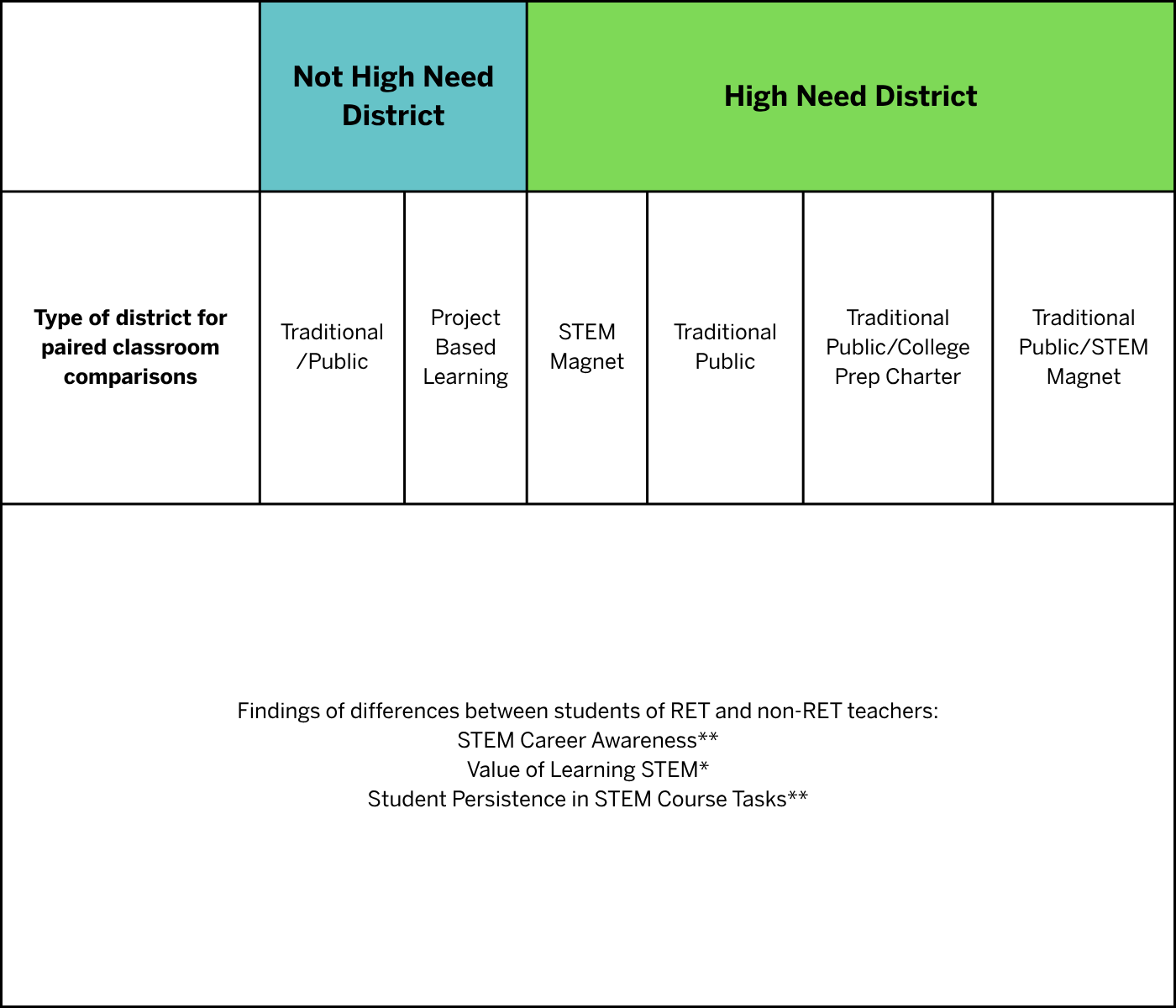
Through our research, we found that students of RET teachers reported stronger perceptions of STEM career awareness, greater value for learning STEM subjects, and a greater propensity to persist in STEM course tasks as shown in the table below. These findings were consistent with teacher interviews in which RET teachers frequently spoke differently about STEM careers and productive struggle compared to teachers who had not engaged in an RET. Specifically, teachers who had engaged in an RET talked about the general context of STEM for its value in society whereas teachers who had not engaged in an RET talked about preparing their students for specific careers related to their discipline, often using career resources provided by a society or a specific curriculum. Additionally, teachers who had engaged in an RET program were able to discuss their own experiences and struggles doing research and hoped to bring the habits of mind they learned – perseverance in the face of failure and the value of productive struggle – into their classrooms for their students. However, our results did not show statistically significant differences in math or science achievement data for students of teachers who did or did not engage in an RET.
The table below summarizes the student perception data gathered through pre and post student surveys of the 16 case study teachers. In the table, we have included the types of districts for the eight paired RET and non-RET teachers. As can be seen below, some of these teachers were teaching in high need districts and some were not. Statistically significant differences are shown by asterisks (* indicates statistical significance at 5% and ** indicates statistical significance of 1%). View full size.
The research to understand the impact of RETs on teachers and students was not easy. It required finding and gathering data from individuals who had participated in STAR up to eight years before. In addition, to gather student data, parental consent and student assent was required for each survey collected, which was a time-consuming process. Despite the challenges, we believe this kind of research is important and should be expanded.
Dual Identities of Teachers
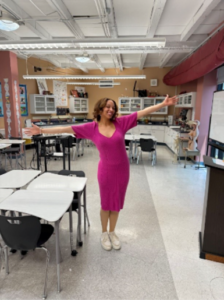
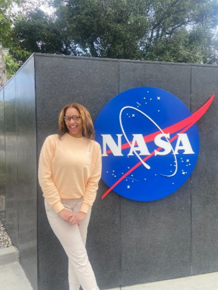
Caption: Aria Fulton pictured in her classroom and during her summer research.
The majority of participants in the STAR Program and other RET programs begin to develop a dual identity, that of a teacher-researcher. We believe that the development of this identity is central to positive outcomes for teachers and their students. Aria Fulton, a recent STAR Fellow (not a participant in our research study) and a third-year high school biology teacher is pictured at her summer research site at the Jet Propulsion Lab and in her classroom. When asked in her first year of teaching about the value of the STAR experience, Aria shared, “Being able to work in industry before I started teaching [was very valuable]. This gave me a leg up in the hiring process because I had research experience as a brand-new teacher. This helped boost my resume.” Most recently, Aria was a panel participant for the national end-of–year STAR conference where she talked about how STAR fundamentally changed how she thought about herself, her teaching, and engaging her students in research.
From reflections she shared with us:
“When I look back, I’m just super grateful [for my STAR experience]. I can explain to kids that there’s other things to do with science that’s not just being a doctor or a nurse… that there are other problems that they could solve, solutions to be made, other people to meet, different industries to work in. It’s given me a bigger understanding of what science really is and knowing that I really do belong in science. When I was in high school or middle school, I never saw examples of Black people who did cool things in science, I didn’t know anyone in my family who was a scientist. And so to do it myself, to know that I belonged in the community and to know that I can write a great paper on research and I can present about it. And my students know that it’s possible for them because I did it myself.” She shared that “I make my kids write full lab reports that mirror my own lab experiences including error analysis because nothing ever goes right the first time. Nothing ever went right for me. So I can tell them hey it’s not going to work out but you still need to write about what could have been better or if you did this again what would you do next time.” Aria also emphasized the communication piece, “It‘s a big deal and I make sure my students know how to write. I make it so that they know how to present their research in front of their classmates, or if administrators come in the room they can speak like scientists and have the language that they need to make it work.”
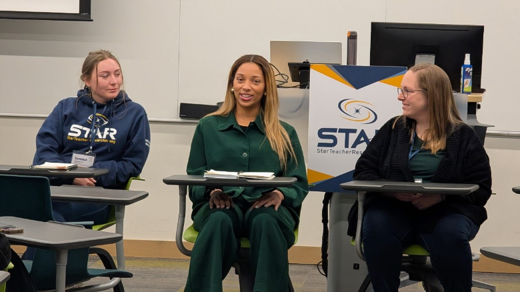
Caption: Aria Fulton speaking on a panel with fellow STAR alums Savannah Scott and Carrie Ann Sharitt.
Recommendations for Teachers
Regardless of background, we encourage all teachers to seek out and participate in an RET. Even teachers with strong backgrounds in research report that engaging in additional research in a new content area illuminates the differences and similarities in how research is practiced across disciplines. For teachers who have never had the chance to do research, we consistently hear how the RET experience changes their perspective on how research is undertaken, fundamentally changes how they think about STEM, and how to engage their students in meaningful learning experiences.
Recommendations for Teacher Educators and Potential Mentors
The findings of our research point to the value of engaging aspiring STEM teachers in mentored research experiences. Interview data pointed to perceived benefits amongst participating teachers. And student perception data revealed statistically significant benefits delivered from RET teachers. For teacher educators interested in supporting STEM career awareness amongst students, value of STEM, and persistence in STEM course tasks, we strongly encourage involving your teacher candidates in research. Additionally, many research mentors indicate perceived impact on K-12 education based upon their involvement with teacher-researchers. We highly recommend that potential mentors consider the positive impacts their mentorship can have on both young professionals entering the teaching profession as well as on workforce development of future STEM professionals.
Acknowledgements: We highlight our co-authors who have contributed many years to this work. Each of our other Co-PIs, Stamatis Vokos, Dermot Donnelly-Hermosillo, Deidre Sessoms, were instrumental in recruiting participants, study design, and writing. Other co-authors including Elsa Bailey and Dan Moreno were instrumental in data collection and the development of the theoretical framework of the study. In addition, we are grateful to our co-authors from AIR, Martyna Citkowicz, Melissa Yisak, Bo Zhu, Eleanor Fulbeck, Charlotte Chen, and Max Pardo for their support in data collection and extraordinary data analyses. Two authors, Dan Moreno and Bo Zhu, participated during their graduate studies which not only enriched the study but also provided leadership opportunities to both in the data collection and management of the study. Lastly, we are forever grateful to Kaylene Wakeman who has supported all of the students, mentors, and workshop leaders of the STAR program since its inception.

Sanlyn Buxner, Ph.D., Research Professor, University of Arizona
buxner@email.arizona.edu
Sanlyn Buxner is a Research Professor in the Department of Teaching, Learning, and Sociocultural Studies at the University of Arizona. Her research focuses on understanding the impact of research experiences on teachers, students, and community scientists, as well as exploring non-traditional ways to engage youth and families in science learning.
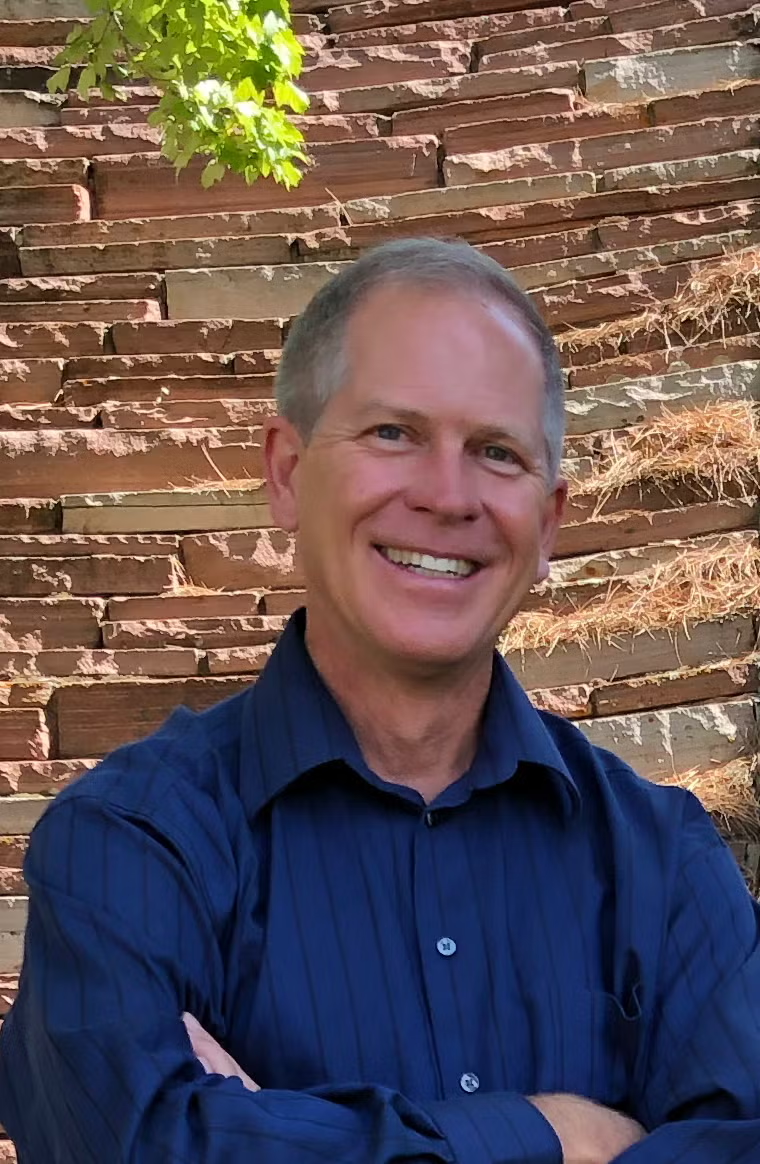
John M. Keller, Ph.D., Director, Fiske Planetarium; Professor, Astrophysical and Planetary Sciences, University of Colorado Boulder
john.m.keller@colorado.edu
John Keller is the Director of Fiske Planetarium and a Teaching Professor of Distinction in Astrophysical and Planetary Sciences at the University of Colorado Boulder. Keller is also Professor Emeritus in Physics from Cal Poly San Luis Obispo, where he served as Executive Director of the STAR Program from 2010-2017. Keller is actively engaged in citizen science astronomy research as well as Astronomy Education Research into teaching and learning in planetarium settings.
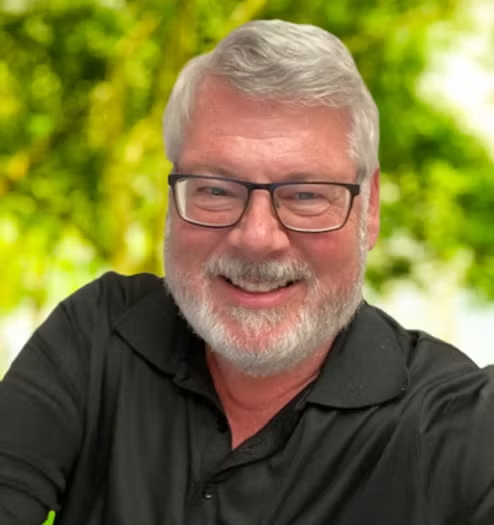
Larry Horvath, Ph.D., Professor Emeritus Secondary Education, San Francisco State University
Larry Horvath recently retired as Professor and Chair of Secondary Education after 17 years at SFSU. He earned his Ph.D. in Science Education in 2008 from the University of California, Davis. He has taught middle school science and high school Biology and Chemistry for thirteen years in California and internationally. His research interests include the teaching and learning of science through inquiry and the development of STEM teacher leaders committed to careers in urban schools. In addition to Department Chair, Dr. Horvath was the Director of the San Francisco State University Center for Science and Math Education (CSME).